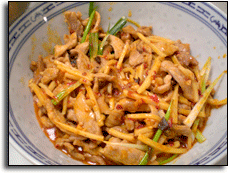
Living in downtown (University and Dundas) Toronto is like living on the moon: It is grey, the concrete makes it rock-like, and there’s very little in the way of atmosphere. This is not to say that there’s no cachet. Indeed, I relish the neighbourhoods that add spice to the otherwise uninteresting corporate epicentre. One of those neighbourhoods is Chinatown, where I got the General Tso Chicken
spices and inspiration for this well loved staple of Chinese cooking: General Tso Chicken.

This dish is also known as General Tsao, General Taso, General Toa, General Cho, General Gau, General Ching, General Kung and General Tseng (according to Eileen Yin-Fei Lo in The Chinese Kitchen, at 416). No matter what it’s called, it is rightly a popular addition to any Chinese restaurant’s menu and a crackerjack head turner at a dinner party. The versions I have here is adapted from Fuchsia Dunlop’s incredibly second oeuvre, Revolutionary Chinese Cookbook: Recipes from Hunan Province – a book I highly recommend for anyone interesting in Chinese cooking, culture, folklore and foodlore. Here’s what you’ll need to make her “Changsha version”

INGREDIENTS

Peanut oil for deep/shallow frying

Bowl 1 (chicken and marinade)
12oz. of boned chicken thigh, skin on, and chopped into bite sized morcels
2 teaspoons of soy sauce (dark or light, but if you’re using dark try cutting it with ½ tablespoon of water or chicken stock)
4 tablespoons of potato flour (rice flour will do in a pinch)
1 egg yolk

Bowl 2 (chillies)
8 dried red chillies, seeds removed and chopped up (roughly should do the trick)

Bowl 3 (ginger)
1½ tablespoons of ginger, chopped finely

Bowl 4 (tomato paste)
1 tablespoon of tomato paste

Bowl 5 (sauce)
2 teaspoons of soy sauce (dark or light, it’s as you like)
3½ tablespoon of stock
2 teaspoons of Chinkiang vinegar (if you’re unable to find this type of vinegar, you can cheat and use balsamic vinegar)
2 teaspoons of white sugar
½ teaspoon of potato flour

Bowl 6 (scallions)
3 scallions (green part only) sliced

1. First, mix together the ingredients of your marinade (bowl 1) and put in your chicken to soak up all the lovely flavour.

2. While you chicken is enjoying its bath, put enough peanut oil in a sturdy pot and heat it up to 180-200C (350-400F). (NB: I usually find that this requires too much expensive peanut oil, so I actually heat up a baby finger’s-worth of peanut oil in a frying pan and shallow fry the chicken. It doesn’t seem to mind.)

3. While your peanut oil is heating up, you can prepare your bowls of goods.

4. Once the oil is at the appropriate temperature, take your chicken out of the marinade and deep fry it until golden and crispy. Set it aside. (NB: My cheater’s shortcut of shallow frying in a frying pan, of course, affects the crispiness of the chicken as it reduces the oil temperature, so I try to split the difference and do small batches at a time).

Now, for the big show.

5. Put in 1-2 tablespoons of oil in your frying pan/wok and heat on medium-high heat. Add your chopped dried chillies (Bowl 2) and stir-fry for 30-45 seconds, making sure they don’t burn.

6. Next, add your ginger (Bowl 3) to the frying pan/wok and stir fry for about 1 minute or just long enough for the ginger to begin to release its delicious fragrance. Again, be careful not to burn it.

7. Add your tomato paste (Bowl 4)

8. Now, add your sauce (Bowl 5) to the frying pan/wok and mix it up, combining all the ingredients. Add your deep/shallow fried chicken and coat it well with the sauce. Throw in the scallions, mix them into your sauce, and then turn out the mixture into a bowl. Serve immediately.

This is really a great dish, and leftovers (a rare occurrence in my house, I assure you) can be used for a great lunch bento. This is truly a fabulous recipe, and so simple you’ll wonder why you haven’t made it before.

I recently got my Toronto Public Library Card, and have gone hog wild borrowing recipe books. On the top of my list were some Chinese cookbooks I’ve been meaning to check out, but haven’t seen at my local book stores. One such book, entitled The Chinese Kitchen, by Eileen Yin-Fei Lo was near the top of my list. After flipping through the book, I came across Mah Paw Dau Fu, a Sichuan classic Mah Paw Do Fu
that I knew under its Japanese moniker, “Mabo Dofu”.The version in Yin-Fei Lo’s book is slightly sweeter than the Japanese version my wife loves to make (in fact, I’m glad to say that it’s her signature dish) and reminded me of a kind of Chinese BBQ sauce, but with an Asian twist. When I sat down to make it tonight, I didn’t have any tofu, so I tweaked the recipe a bit and replaced the tofu with eggplant. Here is my version of Mah Paw Dau Fu. I made it in a frying pan, for which I’m sure I’ll be branded heretic by Chinese cooking purists.

INGREDIENTS

SAUCE
1 1/3 cup of Chicken Stock (homemade, please!)
3½ teaspoons of soy sauce
3 teaspoons of white vinegar (or Chinese rice wine vinegar, if you can get your hands on it)
1 tablespoon of Chinese cooking wine
1 tablespoon of sugar
¼ teaspoon of salt
¼ cup of ketchup (this is quite a sweet dish, so feel free to reduce this ketchup to 1/8 cup)
2 tablespoons of cornstarch (in a pinch, you can use rice flour)
1 tablespoon of sesame oil

EGGPLANT
1 large eggplant (two or three handfuls worth) chopped up in bigg’ish bite sized pieces
¼ cup of vegetable oil

BOWL 1
2 teaspoons of minced ginger
3 red Thai chillies, finely chopped

BOWL 2
2 teaspoons of minced garlic

BOWL 3
½ pound of lean ground pork

BOWL 4
2 tablespoons of Chili Sauce

CONDIMENTS
½ cup of scallions

RECIPE
1. First off, chop up your eggplant, rinse the pieces lightly in water, put the pieces in a bowl, and salt them. Let them sit in the bowl for about 20 minutes while you prepare the rest of the dish. The salt will draw out the bitterness of the eggplant, as well as the water. While that’s going on, set up your rice cooker and chop up the ingredients in all of your bowls. I use the bowl method because it is really the simplest way to plan your work (and then work your plan).

2. After your eggplant has sat in the salt for 20 minutes, rinse it down, drain off any liquid, and pat the eggplant dry – this will prevent the oil from “spitting” at you when you fry the eggplants. Next, heat up a frying pan to medium-high, and put in your vegetable oil. Once the oil begins to look hazy and hot (even a bit smoky is ok), carefully toss in a pan-full of eggplant and fry them until they are golden. Repeat as often as required. Remember not to crowd your eggplant pieces; this will steam them more than fry them. Once you’ve fried all your eggplant pieces, set them aside in a bowl (and keep them warm, if you can).

3. Clean out your frying pan, turn down the heat slightly, and put in the peanut oil (mmm….I love that smell). Once the oil is hot (but not too hot, you don’t want to burn your ingredients) toss in the Bowl 1 ingredients (ginger and chilli) for 1 minute to soften them up.

4. Next, throw in the contents of Bowl 2 (garlic) and fry for 30 seconds. Then, toss in your pork (Bowl 3) and break it up with a wooden spoon as it cooks. Once the pork is cooked and no longer pink, add the chilli sauce (Bowl 4) and combine it will with the contents of the pan. Now, add the eggplant, mix it up, turn up the heat to medium-high, and dump in your lovely sauce. Let the sauce simmer for about 3-5 minutes – just long enough to heat up and thicken to your liking.

5. Pour out the lovely mah paw dau fu into a large bowl, sprinkle with your scallions, and serve immediately with your rice.

One of the great things about Yin-Fei Lo’s book is how she compliments some of her recipes with the stories behind the dishes. The story of mah paw dau fu is interesting. According to legend, a woman with pockmarked skin started up a restaurant and served the dish to her customers. She did not, however, name the dish but the somewhat insensitive customers decided to name it after her: “the pockmarked grand-mother’s tofu”. It is truly a testament to the deliciousness of this dish that despite such an unpalatable name it should be as popular as it is.

My wife recently quit her thankless job, and to celebrate her new-found freedom we decided to try a local Japanese restaurant we’d heard a lot about: Japan GO. Japan GO is located at at 122 Elizabeth Street, about 3 blocks East of University, a little South of Dundas St. West. The restaurant is intimate to say the least; it seats 20 patrons at most though you never get the feeling
you’re crammed in. The decor is unpretentious and reminded me of my old favourite sushi places I used to frequent in Japan. In fact, the name “Japan Go” means “Japan Hometown”, suggesting a feeling of familiarity and comfort.

The menu is also quite traditional, serving your usual sushi and sashimi deals. There is also a respectable selection of Japanese alcohols (though a little shochu would not go amiss!).What really impressed me was the sashimi donburi, a delicious sashimi selection on top of a bowl of rice. My wife ordered it, and the dish was exquisite. The quality of the rice – nicely seasoned short grains – was excellent and only to be outshone by the melt-in-your mouth assortment of fish, including BC salmon.

I opted for the sushi dinner (regular) with an assortment of sushi and maki (California rolls). Again, the the fish and rice were excellent, but the presentation was, quite frankly, astonishingly poor. The maki were rolled well, but the nigiri sushi looked like lifeless, flaccid hunks of flesh. The fish was cut unevenly, the shape was completely off, and the nigiri’s rice bed was sorely lacking.

That aside, I would certainly recommend Japan Go, and I will definitely go back for another round. In fact, I believe this Friday is free…

A few weeks ago I went to visit my parents to check out their newly renovated backyard. The weather was wonderful, and I wanted to bake a nice desert with seasonal fruits to enjoy in the comfort of their new digs. At the time, cherries were the order of the day, and so I bought a few boxes and found this recipe for a cherry tart from The Silver Spoon.

The more I use the Silver Spoon, the more I realize that the recipes are sometimes difficult to work with. Most of them are articulated in one long, dense paragraph, leaving it up to the reader to parse out each step. Consequently, I’ve decided to break down the steps in to more user-friendly steps. But first, here’s what you’ll need for this pie:

Ingredients - Crust
1 fresh egg
2 fresh egg yolks (one for the crust, the other to glaze the crust)
1/4 cup of sugar (superfine, if you can get your hands on it)
Rind of 1/2 a lemon (if you don’t have a lemon, buy one! It is well worth having the rind)
2/3 cup of butter (diced and soften – leaving it at room temperature for 20 minutes should do it)
1 ¾ cups of all-purpose flour (sifted)

Ingredients - Filling
1 cup of milk
½ teaspoon of high quality vanilla extract
2 egg yolks
½ cup sugar
¼ cup all purpose flour (sifted)
1 ½ cups of butter
1 ½ cups of black cherries, pits out
3 tablespoons of brandy (2 for the pie and the other for you!)

Step 1: Making the Crust
Begin by making the crust. In a large bowl, beat the salt, egg, one of the egg yolks, sugar, and lemon rind with an electric mixer. Once the ingredients are well incorporated, gradually beat in the butter. Once the butter is properly mixed in, stir in the sifted flour and mix. You now have the base for your dough. It should be supple but not sticky.  If you find it is too sticky, add a bit more flour.

Next, take your lovely lemon-scented dough and kneed it lovingly for a few minutes. Then, shape it into a ball and put it in the fridge for half an hour.

Step 2: Making the Filling
While your dough is in the fridge, take your milk and mix in the vanilla extract. As vanilla extracts can vary in quality and intensity, give the milk-extract mix a taste to see if you want to add any more vanilla. The purpose of the vanilla is not to be overpowering, but only to add a nice background flavour and highlight the cherries. Heat up the mixture, but don’t let it boil. Set it aside for now.

With your electric mixer, beat together the 2 egg yolks, sugar, and flour.

Slowly add the warm milk to the egg-sugar-flour mixture, and mix constantly as you do so. Now, take this mixture and put it into a pan. Bring it to a boil over low heat and continuously stir until the mixture thickens up. You’ll know when it’s thick enough when you get a custard-like texture. Be careful not to dry out the custard, but if you do the liquid from the cherries (which you will eventually add) should rehydrate an otherwise dry custard. Once you’ve got your custard texture, add the butter. This will give your custard a nice sheen. Remove the custard from the pan, put it in a bowl, and let it cool.

Step 3: Preparing the Cherries
Add your cherries, sugar, and 2 tablespoons of brandy to a pan and bring to a boil over low heat. Let it simmer for approximately 8-10 minutes. Stir your cherry mixture from time to time, to make sure every inch gets a chance to absorb the brandy and sugar.

While you’re mixing your cherries, pre-heat your oven to 200°C (400°F).

Step 4: Preparing the Crust & Loading Up the Tart
Butter a tart pan and set it aside for now. Then, remove your dough from the refrigerator, and roll out 2/3 of it. The crust should be large enough to fit comfortably into your tart pan. I found this dough to be unruly and difficult to work with (it crumbled quite easily), but be patient because I can assure you its well worth the trouble.

Take your rolled dough and place it in the tart pan. Next, pour your custard into the dough-lined tart pan, and spread it out evenly. Now, put in your cherries and spread them along the top of the custard.

Take the rest of your unused dough, and roll it out to be large enough to comfortably cover your tart. Place the dough over the tart, seal the tart along the edges, and cut a hole in the centre of the dough. Finally, brush the remaining egg yolk over your tart and put it in the oven for 45 minutes.

If all goes well, you will be left with a beautiful, golden crust, and a juicy cherry centre. This is a fabulous desert and quite straight forward. It goes very well with vanilla ice cream. Bonne appétit!

In my opinion, Toronto’s best food festival is the “Taste of the Danforth” in Toronto’s Greektown.  To be sure, Toronto has other great food festivals.  Summerlicious is a great way to sample menus from some of Toronto’s more upscale eateries, and other cultural festivals are always chock-a-block with delicious food stalls, but in my humble opinion the Taste of the Danforth has what all the other festivals lack: quality and variety.


A restaurant which opens its doors during the Taste of the Danforth is Mezes.   Meze” is the Greek word (Mezés or Μεζές) for what is popularly known as tapas or “appetizers”.  Went there recently with an open mind and an empty stomach and came out amazed.

Mezes’ decor is classy yet relaxed - one would be as comfortable having a meal there in shorts and a T-shirt as in business casual or more formal attire.  The service is similarly informal but efficient.  Our waiter was extremely knowledgeable and had a great sense of humour.  He made sure we had drinks as soon as we were seated and (following a perfunctory Ouzo shot) he must have picked up on some vibe we were putting out because he was taking our orders as soon as we’d decided what to eat.


The menu at Mezes is vast and includes far more than the usual token tzatziki and hummus platters.  The appetizer menu is epic, and a friend of mine suggested ordering an appetizer each and then sharing them all.  We ended up splitting the difference, and ordered the Kria Poikilia (an array of popular dips Tzatziki, Taramosalata, Homous, and Melitzanosalata served with pita) and I ended up ordering the (wait for it…) lamb souvlaki.  Yes, I know.  It’s a bit cliché, but I just had to see how they cooked this classic dish.  I was not disappointed.


The lamb was cooked to perfection (medium rare…any more cooked and its a waste of meat); it was succulent, juicy and tasty.  The Olympus-sized rice mound that accompanied the dish was also fabulous and fluffy.  I have to say the salad was a bit of a let down, but – hey – with everything in front of me I hardly had room to put away a few mouthfuls of greenery.


Mezes’ was a great experience with good food at a very reasonable price.  If you do end up going, however, get there early because it’s extremely popular.  We had to wait 45 minutes for a table.  If you do end up waiting, however, fear not.  Mezes is just up the street from a cluster of great stores.  I would HIGHLY recommend Mezes if you’re looking for a good time in a friendly, charming restaurant.

Yesterday night I went out with some friends for some post-theatre dinner and we ended up at Thai Basil, a classy Thai place at 467 Bloor Street West.  I’ve been pretty disappointed with restaurants in Toronto since arriving from Montreal, but I have to say that Thai Basil really raised the bar in terms of taste, atmosphere, and price.


The restaurant itself is narrow, but wouldn’t know it because of the intimate atmosphere and the layout of the tables.  We were there at 9:30pm on a Saturday night, but we managed to get a table in no time flat.  The staff was quick to greet and seat us, and we weren’t waiting for 10 minutes before our drinks were ordered from their long and unbelievably reasonable drink menu.


The menu consisted of your normal Thai standards, but went far (…far!) beyond what you’d get at most Thai places in Toronto.  The food choices ranged from starters (spring rolls, soups, and friends), to salads, to rice dishes, to curries, to seafood;  to pork, chicken, or beef; to deserts…etc.  If anything, the menu had too much choice and I tried to imagine the poor chefs in the kitchen contending with the dizzying variety of orders that come in each night.


I settled on Thai Basil Eggplant and Pork Hot Pot, and I wasn’t disappointed.  The dish was served piping hot and perfectly seasoned.  The texture of the fried eggplants was delightful, and the sauce used to bring this dish together was robust and spicy.  The quality of jasmine rice I ordered to accompany the dish was also excellent and moist – indicating that, unlike other Asian restaurants (Hosu, I’m looking to you!) in Toronto, it hadn’t been sitting in a bowl for hours before being served.


Being the shameless foodies that I am, I also had a chance to taste the coconut soup, which was also outstanding.


Overall, I’d rate Thai Basil as one of the best Asian food restaurant experiences I’ve had in Toronto.  It was all the things I look for in a restaurant:  service was quick, the food refined, and everything was consistently good.  If you’re even looking for nice meal at a reasonable price, I would highly recommend Thai Basil.

Finally, now that the dust has settled and my life has returned to normal, I’ve decided to re-commit to this blog.  Unfortunately, my computer has melted down, making it harder to write without the benefit of Photoshop and the other goodies on my noble Toshiba Satellite, but I have this chopped down computer and I’m always up for a challenge.

No sooner have I returned from Japan that I am thrown into my Bar (i.e., law licensing) exams. The last one is on June 7. After that, and following a trip back to Montreal, it’ll be full speed ahead with the blog and some of the lovely recipe books I got in Japan. Stay tuned!

Time for a break and some food research in Japan.  Stay tuned for authentic J-land recipes coming soon!

For the past few months my friend Jannes has been talking about his love of Chinese food and his new passion for Chinese cooking. Now, for the vast majority of us who have never been to China, our idea of Chinese cooking is limited to chicken balls, cherry sauces, and spring rolls. Consequently, it was a pleasure when Jannes invited me down to learn how to cook some more traditional Sichuan dishes. During our cooking  
clinic, I was put in charge of a dish called Fish-Fragrant Pork Slivers (yu xiang rou si) – a mind-blowingly delicious dish that I can hardly wait to make again.

The recipe is from a book called Sichuan Cookery by Fuchsia Dunlop, an authority on Chinese cooking in the West. I can honestly say that the result is fabulous – as is the cultural and culinary explanations that precede every recipe in her excellent book – however I found her writing to be imprecise and the instructions sloppy. The key to cooking this recipe (and most Chinese dishes, I imagine) is mise-en-place; you need to have your little bowls of seasoning and ingredients waiting to be tossed into the wok. Dunlop’s book, however, does not break down its instructions into the contents of each bowl. Rather, it is a mishmash of sometimes confusing directives.

In my humble opinion, my instructions on the dish are clearer, though I cannot claim to improve upon what is an incredible recipe.

Here’s what you need for this recipe (serves 3):

75ml of cooking oil (groundnut or peanut oil, or corn oil)

300g of lean pork, cut into thin 3mm x 3mm x 3cm slivers (“julienne” them)

Marinade
¼ teaspoon of salt
1 teaspoon of light soy sauce
1 tablespoon of cold water
1 tablespoon of potato flour (potato starch is a decent substitute)
1 teaspoon of Shaoxing wine (if you don’t have any, use sherry)

Sauce
1½ teaspoons of white sugar
1½ teaspoons of Chinkiang or black Chinese vinegar (balsamic vinegar will do)
¾ teaspoons of light soy sauce
½ teaspoons of salt
¾ teaspoon of potato flour (again, potato starch will do in a pinch)
3 tablespoons of stock (chicken) or water

Bowl 1
2 tablespoons of chilli paste

Bowl 2
2 teaspoons of finely chopped garlic
2 teaspoons of finely chopped ginger

Bowl 3
75g of bamboo shoots
1 handful of cloud-ear mushrooms

Bowl 4
1 spring onion, chopped

Ok…get to work. First, chop up your meat, make the marinade, and then combine the two. Make sure to thoroughly coat your meat and let your it marinade for at least 30 minutes. If you have a rice cooker (if you don’t, buy one!) you can start making the rice.

Next, take your cloud-ear mushrooms (which will likely be dehydrated) and soak them in very hot water for 30 minutes. While the mushroom are hydrating, boil some more salted water and blanch the bamboo shoots for about a minute or so. Rinse them in cold water and then julienne them in slices similar in size to the pork.

Now, get to work preparing the contents of the other bowls, which should be self explanatory. Once the mushroom are ready, chop off any hard, nubby bits, and then slice them into strips the size of the pork and bamboo shots.

You should now be locked and loaded – which is good because the next step will be fast and furious. Season your wok (if you don’t your meat will stick) and heat up the 75ml of oil over high heat.

Once the oil is nice and hot, throw in your marinating meat and cook until the pieces are white on all sides (about 1-2 minutes). Then, keeping your wok over the heat, push your meat to one side of the wok and tilt the wok at about 30° so that the oil pools opposite the meat. Put your chilli paste into the oil (but not the meat). Mix up your paste/oil mix until well incorporated in the oil (about 30 seconds) and try not to let any meat drop into it.

Next, add the garlic and ginger in the chilli-oil mix until you can smell them.

This is the home stretch. Level your wok and rest it on the heating element. Throw in the bamboo shoots and cloud-ear mushrooms, and fry for 30 seconds. Stir in the sauce and mix quickly, then toss in the spring onions. Mix for about 10-20 seconds and serve immediately.

Next Page »